
Why We Build On WordPress
Every web company has a platform they prefer. Here is ours, and the honest reasoning behind it. WordPress is our primary platform for designing and developing device-responsive websites. That is not because it is what we happen to know — it is because for the vast majority of businesses, it produces the best outcome across the three things that matter most: whether the platform will still be here in ten years, whether you can update your own website, and whether it can do the thing you need it to do next year.
The Web Content Manager That Delivers
Every web company has a platform they prefer. Here is ours, and the honest reasoning behind it. WordPress is our primary platform for designing and developing device-responsive websites. That is not because it is what we happen to know — it is because for the vast majority of businesses, it produces the best outcome across the three things that matter most: whether the platform will still be here in ten years, whether you can update your own website, and whether it can do the thing you need it to do next year.
WordPress powers roughly 40% of all websites, and close to 60% of every site built on a recognized content management system. Those numbers come from W3Techs, which tracks platform usage across the web, and they have held remarkably steady for years. Scale like that is not a popularity contest — it is a practical advantage, and it compounds in ways that are easy to overlook until you need them.
• You are never locked in to us. Any competent WordPress developer can pick up your site. If we vanished tomorrow, or you simply wanted to work with someone else, you would not be stranded with a proprietary system only one company understands. We think that is how it should be.
• The platform is not going anywhere. WordPress is open source, backed by a foundation rather than a single company, and maintained by a global contributor community. There is no vendor who can be acquired, pivot, or shut down and take your website with them.
• Everything integrates with it. When a software company builds integrations, WordPress is the first one they build. Your CRM, email platform, booking system, and accounting software almost certainly already connect.
• Problems are solved problems. Whatever you need to do, thousands of businesses have needed it before. That means mature solutions, documentation, and a fix that already exists rather than one that has to be invented.
Easy Edits You Can Do Yourself
This is the reason that matters most day to day, and the one clients tell us they value after a few months of ownership. A website you cannot change is a liability. If updating your hours, swapping a photo, correcting a price, or publishing an announcement means emailing a developer and waiting two days, those changes stop happening. The site slowly drifts out of date, and an out-of-date website costs you credibility with every visitor who notices. WordPress is built for people who are not developers. The editor works much like any document editor you have used: you click on text and type, you drag an image into place, you press a button to publish. Someone comfortable with email and Word can manage their own content, and most of our clients do within a week of handover. We reinforce that on purpose. We build with a visual page builder so your layouts are editable rather than locked, set up user roles so team members can only change what they should, and train your team on the specific tasks they will actually perform — not a generic tour of every menu. You get documentation written for your site, in plain language. The test we use: if you cannot change your own phone number without calling us, we have built the wrong thing.
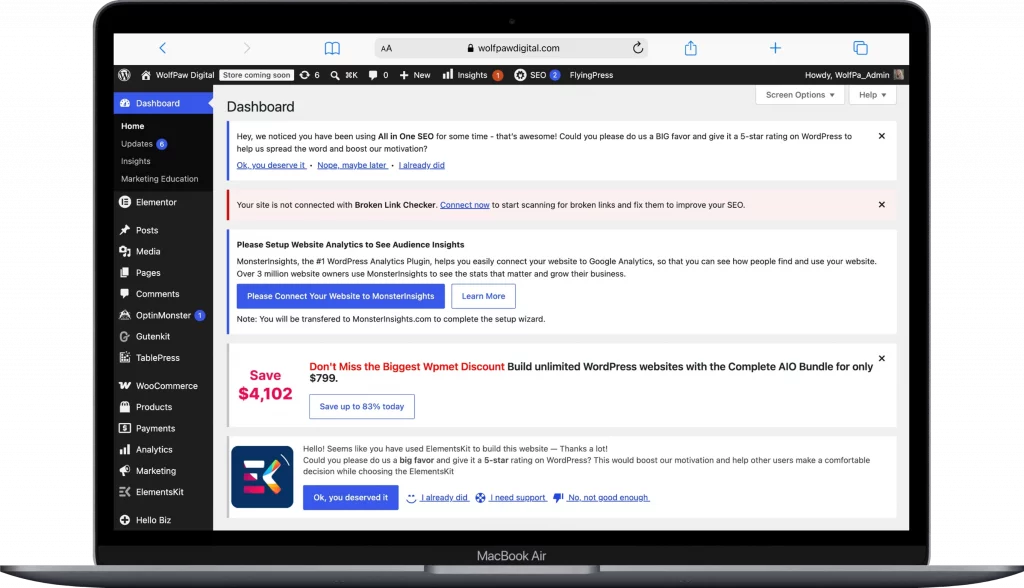
Flexible and Supported - It gets needs met
WordPress on its own is a content management system. What makes it genuinely flexible is the plugin ecosystem — more than 50,000 free plugins in the official directory, plus a large commercial market of professionally supported extensions. In practical terms, this means functionality that would cost tens of thousands to build from scratch is often a mature, well-tested extension that has been refined over a decade of real use
Why We Are Selective About Plugins
The plugin ecosystem is WordPress’s greatest strength and its most common issue creator. Every plugin is software written by someone else, updating on its own schedule. A site with forty plugins has forty things that can break, forty potential security exposures, and forty reasons the site is slow. So we treat plugins as decisions rather than downloads. We use as few as the job requires, choose actively maintained ones with a track record, prefer a small amount of custom code over a heavyweight plugin that does one thing you need and thirty you do not, and remove anything that stops earning its place. This is also why we test every update on a staging copy before it reaches your live site. Most of the time the horror stories people have heard about WordPress trace back to the installation of too many plugins fighting against one another and neglected updates that can leave them open to security risks — not to WordPress itself.
When WordPress May Be The Wrong Choice
WordPress gives you ownership and flexibility, and both come with responsibility. The site needs proper hosting, regular updates, and someone paying attention. If you want to publish a handful of pages, perhaps provide shopping hub, never wish to think about maintenance and accepting the limits of a closed platform in exchange, a fully hosted service may genuinely serve you better. We would rather tell you that in the first conversation than build you something you did not need. Ask us — the answer is not always WordPress.
FAQ's
Do I need to worry about my site security?
WordPress core is actively maintained and patched quickly. The overwhelming majority of compromised WordPress sites were running outdated plugins or weak credentials — not a flaw in the platform. Kept current on solid hosting, it is as secure as anything else on the web.
Is WordPress slow?
Poorly built WordPress sites are slow. Bloated themes, unoptimized images, too many plugins, and cheap shared hosting are the usual causes, and all four are choices rather than platform limitations. Built carefully and hosted well, WordPress is fast.
Do I have to purchase plugins?
Many are free. Some are worth paying for — a commercial plugin with a support team and a funded development roadmap is often the safer choice for anything business-critical. The plugins we suggest are premium versions of Elementor Pro, All in One SEO and a top selling caching plugin Flying Press. We tell you which is which before you buy anything, and license costs are yours rather than marked up by us
Do you work with other platforms?
WordPress is our preference, but we also work with Shopify and Squarespace where they are the better fit for the business.
