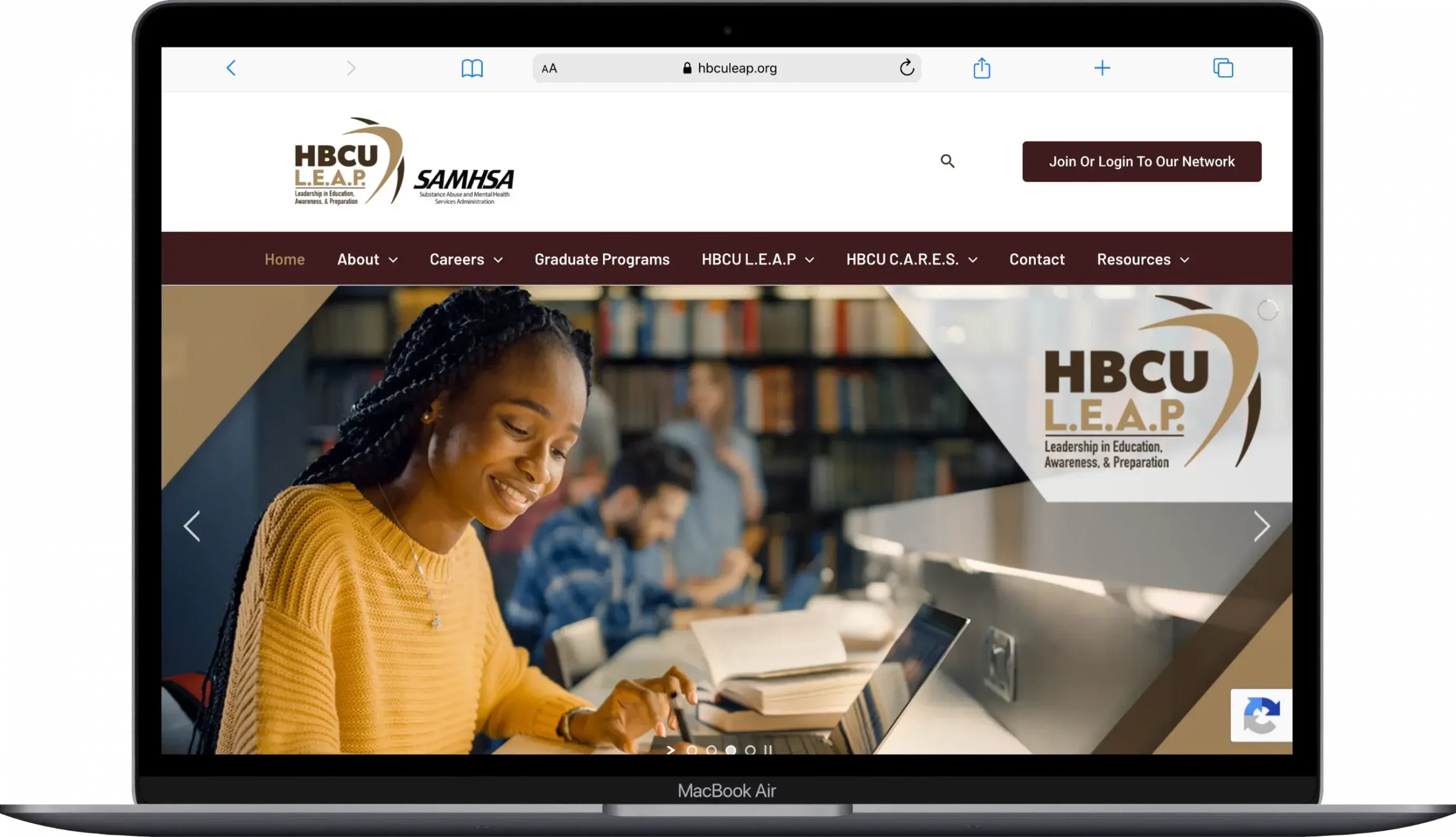
A nonprofit initiative preparing the next generation of behavioral health leaders wanted a clean-no clutter, easily navigable website that could do three things at once: tell a mission-driven story, publish and maintain a growing archive of student and mentor profiles, and hand visitors off cleanly to a separate alumni networking platform. I designed and built all of it for 219group, Raleigh, NC, as a contract web developer.
What Shipped
146
DYNAMIC PROFILES
2
CUSTOM DIRECTORIES
21
PAGES DESIGNED
1
API INTEGRATION
The Client
HBCU L.E.A.P. exists to close a documented gap in the behavioral health workforce. The organization’s own research framing, published on the site, lays out the problem plainly: only a small share of behavioral health practitioners come from diverse backgrounds — roughly 6% of psychologists, 13% of social workers, and 21% of psychiatrists — while federal projections point to broad shortages across psychiatry, psychology, counseling, social work, and family therapy.
Its mission is to raise awareness of and offer access to behavioral health fields for diverse students, working through HBCU partnerships.
Two flagship programs carry that mission:
• The Pre-Career Footsteps Mentoring Corps (PCFMC) — selects twenty-five graduate students, medical students, and psychiatry residents each year, pairs each with a field mentor, and supports them with stipends and professional development.
• HBCU C.A.R.E.S. — the predecessor initiative (2018–2023), which produced Behavioral Health Ambassador Program and its annual cohorts of student ambassadors.
The Challenge
219 Group brought me in to handle design and development on a build with three distinct problems layered on top of each other.
1. A living archive, not a brochure The organization had years of cohort history to publish — individual ambassadors and mentoring corps leaders, each with a headshot, degree program, home institution, and a written biography answering “Why Behavioral Health?” Hand-building these as static pages would have meant hundreds of manually maintained layouts, with formatting drifting a little further out of alignment every year. Non-technical staff needed to add a new cohort without touching a template.
2. Two audiences with opposite needs Prospective students arrive wanting to know what careers exist and which HBCUs offer the relevant graduate programs. Alumni and established professionals arrive wanting to find each other and give back. The same site had to serve a nervous undergraduate and a practicing psychiatrist without feeling scattered to either.
3. The network lived somewhere else The alumni and mentorship community runs on a separate third-party platform at hbcu-cfenetwork.org — a dedicated networking product built around connecting graduates, offering mentorship to current students, and expanding professional networks. It was never going to be rebuilt inside WordPress, and it shouldn’t have been. The problem was integration: making two systems feel like one organization.
SCOPE & MY ROLE
I was responsible for the design and development of the entire project — every page, built to the client’s stated needs and refined through the agency relationship with 219 Group.
| Workstream | What I delivered |
|---|---|
| Design | Visual design and layout for all pages of the site, developed from the client’s brand, content priorities, and stated goals. |
| Front-end build | Every page constructed and made responsive — home, mission and vision, leadership, advisory council, five career-pathway pages, graduate programs, program overviews, cohort directories, resources, and contact. |
| Custom data architecture | Two custom post types with their own templates, taxonomies, archive routing, and SEO handling, so cohort records behave as first-class content rather than page copy |
| API integration | Connection to the third-party alumni network platform, giving graduates a path into mentorship, peer connection, and career pathways from anywhere on the site. |
| CMS handoff | Editorial structure that lets staff publish a new cohort, add a profile, or update a career page without developer involvement. |
THE BUILD
Third-Party Alumni Network API Integration
The centerpiece of the technical scope. HBCU L.E.A.P.’s community platform is a separate product with its own accounts, profiles, and connection logic — organized around three functions the platform itself names: connect (find and stay in touch with fellow graduates), give back (introduce, employ, or mentor current students), and expand (leverage a professional network for introductions). I integrated that platform with the marketing site so the two read as a single organization rather than a website and an unrelated login screen. Practically, that meant:
• A persistent, site-wide “Join Or Login To Our Network” entry point, present in both the desktop and mobile navigation — so no matter which career page or cohort profile a visitor lands on from search, the path into the alumni network is one click away.
• Continuity of identity across the handoff, so an alum moving from a mentoring corps profile into the network doesn’t experience it as leaving the organization.
• A structural link between the site’s public-facing mentor and graduate records and the platform where actual mentorship relationships are formed.
Custom Dynamic Directories
Each record carries a structured profile: headshot, degree program, home institution, biography, personal “fun facts,” and the student’s own answer to why they chose behavioral health. Because the data is structured rather than typed into a layout, the same records drive individual profile pages, cohort-year listing pages, and archive views — and every profile is independently indexable, which turns a hundred and forty-six student biographies into a hundred and forty-six organic search entry points.
The directories span cohorts from 2019–2020 through 2025–2026. Adding the next one is a content task, not a development task.
| Directory | Purpose | Records |
|---|---|---|
| Ambassador / graduate directory | Past and present HBCU graduates and behavioral health ambassadors, published at /directory/ | 96 |
| Mentor directory | HBCU ambassadors and mentoring corps leaders, published at /mentor-directory/ | 50 |
I designed and built every page. The information architecture separates the two audiences without splitting the site:
• Career pathways — dedicated pages for counseling, psychiatry, psychology, nursing, and social work, so a student exploring the field has a landing point for each discipline.
• Graduate programs — a behavioral health programs campus search, giving prospective applicants a way to find HBCU graduate programs by field.
• Program pages — the Mentoring Corps and HBCU C.A.R.E.S. sections, including live application routing for the current cycle.
• Organizational pages — mission, vision and goals, leadership, advisory council, resources, and contact.
• Cohort directories — year-by-year ambassador and mentoring corps listings, powered by the custom post types above.
The home page carries a rotating hero, the mission statement, and direct routes to graduate programs and organizational history, with newsletter capture in the footer. Imagery is served in WebP throughout to keep a photo-heavy site fast.
